



Webpage Supplement to
Chapter 1: Playback Theatre
Hannah Fox
Revised, September 5, 2008
Playback Theatre is an interactive, improvisational form used to illuminate life and incite dialogue. In playback theatre life stories are shared by audience members and then re-enacted spontaneously on stage.
Playback Theatre Sampler In this workshop you will play, awaken your senses, exercise yourselves as artists and humanitarians, practice compassionate listening, and learn the fundamentals of playback theatre. Bring water and wear loose clothing. Prerequisite: None
Core Training with Hannah Fox: Workshops for learning the basics, with lots of opportunities to practice. Click here for more information.
Ritual
The playback process can be referred to as a “ritual.” To fully
understand playback theatre, it is necessary to understand the
implications of this term. Jonathan Fox and others have written
extensively on this topic (***refer to Fox’s chapter called “A Ritual
for Our Time” in Gathering Voices or to an essay that I wrote called,
“Theatre, Ritual, and Community” [unpublished]), but I will mention a
few important points here. Because playback theatre is based on
peoples’ personal experiences, it is essential that we create a sturdy
container for this kind of intimate exchange. As mentioned earlier,
following the pattern of life, the stories told in playback range from
comic to tragic, from ordinary to extraordinary. Almost invariably,
during a playback event, there are emotionally charged moments and even
catharsis. An established protocol has evolved that is important to
adhere to in order for both the players and the audience to feel
comfortable and safe.
While it is necessary for playback theatre to remain flexible in order
to accommodate the various applications as well as cultural influences,
here are what I see as five basic elements that need to be in place.
1) Stories are volunteered
2) The teller’s story is about her/his own experience and s/he
watches the enactment
3) Stories are invited without prejudice or discrimination
4) The form is spontaneous
5) The stages of the technique are followed
These elements define playback theatre and help to make the experience
safe and meaningful. Although the form is spontaneous, it is this
formulaic aspect (there are places of repetition and predictability)
make it stable. Fox concludes, “Without a clear framework provided by
the rules, spontaneity can quickly turn into chaos, creativity into
confusion. With it, the members of the audience feel safe enough to let
themselves go into trance, allowing unforeseen breakthroughs” (Fox
& Dauber, 1999, 128).
Ref:
Grimes, Ronald L. Beginnings in Ritual Studies. Lanham, Maryland:
University Press of America, 1982.
---. Readings in Ritual Studies. Upper Saddle, New Jersey: Prentice
Hall, 1996.
(Please note why these
references are here, how they are relevant***)
Schechner, Richard. Essays on Performance Theory: 1970-1976. New
York: Drama Book Specialists, 1977.
Three Circles
Playback theatre is like a multi-faceted vehicle, journeying
along
several roads simultaneously. At once it is belongs in the artistic
arena, in the psychological and social realms, and in the world of
ritual. As critical as the ritual aspect is to the form’s success, so
are the entertainment and social components. Whereas the ritual
protocol in playback is somewhat rigid, the artistic and social
interaction realms are less constrained by rules. There is room in
these two circles for play and experimentation. It is in the social
interaction area that critical relationships are formed, i.e. between
the conductor and the teller and the conductor/actors and the audience.
In the artistic realm we are challenged to consider aesthetics. It is
in the overlapping area, where these three circles meet, that the most
successful playback theatre occurs. This graph illustrates how these
areas merge in playback theatre. (Shall we include the graph? I think
it is quite useful. Refer to Gathering Voices p. 127 )
-
-
-
Cuba, which also has a handful of companies, will soon have a national
playback theatre company, endorsed by the Ministry of Culture. There
has also been a strong effort in Cuba to use the form to hear and see
stories about HIV/AIDS.
New Book:
Rowe, Nick.(2007). Playing the other: Dramatizing personal narratives in Playback Theatre. Philadelphia and London: Jessica Kingsley. ($35, pb, 224 pg. www.jkp.com or jkpmail@presswarehouse.com
New DVD: Paula Patterson, RDT/BCT is pleased to announce the release of
a 20 minute DVD documentary: Acting Healthy:
Playback Theatre in a Medical Hospital. The film
demonstrates the impact that playback theatre has had on the lives
of hospitalized adult and pediatric patients of Shands Hospital
at the University of Florida. Troupe members work at the bedside
and in public spaces throughout Shands Healthcare. The film
is available for $20 which includes postage and shipping within
the continental U.S. To order a copy contact Paula at: swampmail@aol.com
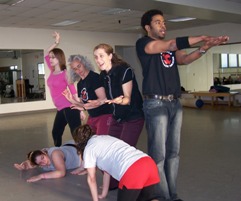
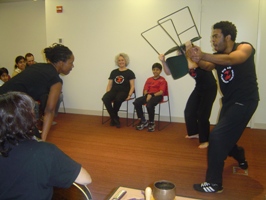
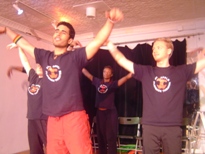
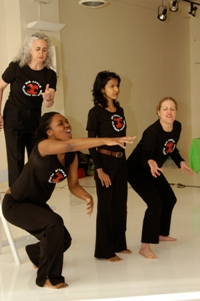
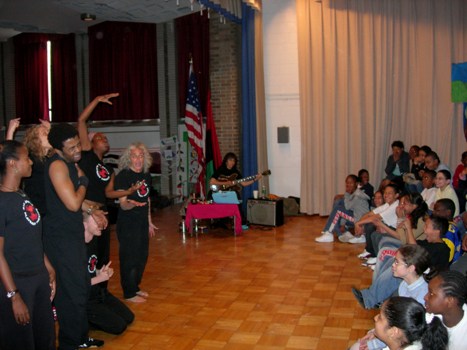
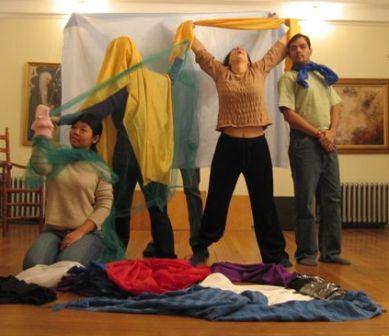
Photos:
 |
 |
 |
|
 |
 |
 |
 |
Added September 4, 2008:
Look at some of the variations! (These were classes proposed by practitioners for 2009
for the Playback Center Teaching Program: (from http://www.playbackcentre.org/Teaching.Proposals.Homepage.htm )
-- Earning money with playback? It’s worth it! An inspiring course about playback and income., by Tjitske Muller and Joke Rood (Holland): We will examine together the possibilities of increasing your income with play back professionally part-time or full-time.
-- Body, Cultural Archive & Artistry, by Rea Dennis (Australia) and Magda Miranda (Brazil): Explore how listening impacts on your body and artistry in playback theatre.
-- Playing the Unplayable: Stories of the Perpetrator, Victim and Witness, by Randy Mulder (USA):This course offers an overview of doing Playback Theatre with the Incarcerated.
-- Time to Dream: Acts of inner service toward spirituality, by József Parádi (Hungary): I believe that acting upon dreams in playback theatre help us to take practical steps toward spirituality.
-- Beyond and along language barrier: Playback Theatre and the Physicality of Language, by Nili Lubrani Rolnik (Israel): Discovering the mulitfunctionality of language in Playback Theatre.
-- Sociodrama for Playback Theatre, by Nadia Lotti (Italy): Using Playback Theatre to integrate a Sociodramatic process. From acting to watching.
-- FEET “Our feet are our face” (No-Theatre, Japan), by Fra Zeller (Switzerland): Expressive emotional feet involve the whole body and lead us into the depths of a story.
-- Using Playback Theatre to explore reactions to and use of authority, by Susan Metz (USA): Use Playback to explore our reaction to and our use of authority.
-- We are all One, by Jen Kristel (USA): Integrating and acknowledging persons with disabilities with and into Playback.
-- Solo Playback Theatre, by Cymbeline Buhler (Australia): Adapting Playback forms to use in solo performance.
-- Living Newspaper, by Cymbeline Buhler (Australia): Combining playback forms to engage with the personal experience of world events.
-- Understanding Playback Theatre, by Jaap Oostra (Holland): In this course we are going to investigate upon the basics of playback theatre. With the insights we gain we improve our practice of performing and rehearsing.
-- Company and business development, by Christopher Ellinger and a co-leader (USA): Learn keys to strengthening company relationships and growing business opportunities.
-- Leadership, by Christopher Ellinger and a co-leader (USA): Support your leadership—and strengthen leadership in your company.
-- Artistic Explorations, by Christopher Ellinger and a co-leader (USA): Learn new Playback forms & artistically transform the familiar.
-- Playback-Theater PLUS, by Karin Gisler (Switzerland): Combinations of Playback-Theatre with other improvisational theatre methods.
-- Kinesthetic Body Theatre (KBT), by Darby Hayes (USA): Maximizing Your Playback through the Power of Body Language.
-- Make Playback Come Alive!, by Allen Hancock (USA): Develop your acting skills using metaphor, ritual, inquiry and other techniques.
-- Performing in Harmony: the relationship between Actor and Musician, by Sarah Urech and Debbie Lan (USA): Explore the relationship between the playback actor and playback musician.
-- The Unchosen Actor (or “Ninja” Actor), by Lauren Ardman and Sarah Urech (USA): Explore the role of the unchosen actor and build skills.
-- Mask and Symbol in Playback, by Fred Harris (USA): Using masks to aid Playback performance and explore social understanding.
. . . and make sure you keep up with the doings and read through the sub-headings at the home page of the Centre for Playback Theatre: http://www.playbackcentre.org/index.htm !